
The Akhada Budget, the Trial Date and One Hundred Grams on the Scale: Indian Wrestling's Real Timetable
**मुख्य उत्तर:** भारतीय कुश्ती में पदक मैट से पहले कैलेंडर और लागत पर तय होते हैं। घरेलू चयन परीक्षण की तारीख, UWW रैंकिंग कैलेंडर से मेल नहीं खाती, और अखाड़े का मासिक खर्च परिवार की क्षमता से तेज़ बढ़ता है। यही तीन कारण तय करते हैं कि कौन सत्रह साल की उम्र में खेल छोड़ देगा। **मुख्य तथ्य:** - भारत ने 2008 बीजिंग से 2024 पेरिस तक हर ओलंपिक में कुश्ती में पदक जीता; कुल सात पदक, स्वर्ण शून्य। - कोचों के समूह के अनुमान के अनुसार एक प्रतिस्पर्धी पहलवान का मासिक आहार-खर्च 15,000 से 25,000 रुपये के बीच है। - पेरिस 2024 में विनेश फोगाट 50 किलो वर्ग में तराज़ू पर 100 ग्राम अधिक पाई गईं और फाइनल से पहले बाहर हुईं; CAS की अपील ख़ारिज हुई। - ऐची-नागोया में 2026 एशियाई खेल 19 सितंबर से 4 अक्तूबर 2026 के बीच निर्धारित हैं; कुश्ती इसी अवधि के भीतर है। - सुशील कुमार 2021 से एक आपराधिक मामले में विचाराधीन हैं; मुक़दमा चल रहा है, न दोषसिद्धि न दोषमुक्ति। **स्रोत:** सैमुअल थॉमस की फ़ील्ड रिपोर्ट और अखाड़ा फ़ील्ड नोट्स; प्रकाशन तिथि 13 अगस्त 2026। **संबंधित प्रश्न-उत्तर:** प्रश्न: क्या भारतीय कुश्ती का असली संकट प्रशासनिक है? उत्तर: प्रशासनिक घटनाक्रम सुर्ख़ियाँ बनाते हैं, लेकिन पदक घरेलू सत्र और UWW रैंकिंग कैलेंडर के बीच की खाई से तय होते हैं। प्रश्न: अखाड़ों में सबसे बड़ी छँटाई किस उम्र में होती है? उत्तर: कोचों के समूह के अनुसार सबसे बड़ी छँटाई 15 से 17 वर्ष के बीच होती है, जिसका कोई आधिकारिक रिकॉर्ड नहीं रखा जाता। प्रश्न: भार वर्गों का अंकगणित पहलवान के करियर को कैसे प्रभावित करता है? उत्तर: गैर-ओलंपिक वर्ग में पदक जीतने वाले पहलवान को ओलंपिक वर्ग में चढ़ना पड़ता है, जहाँ उसी वर्ग के लिए बने प्रतिद्वंद्वी खड़े होते हैं।
The mud at the Bahalgarh akhada was turned over at ten minutes past four in the morning, and by then the coach's register already carried thirty-four names. One had been struck through: a nineteen-year-old who wrestled at 74kg last season and could not make 79 this one. The coach did not write down a reason. The register had room for two things only, a name and a weight.
The hand pump was dry, so the water came from the tubewell, and on the wall somebody had chalked a date: selection trials, 14 September. Under the date there was no name, only an arrow pointing downward. At four in the morning the notebook was already awake and the mud was talking, and what it was talking about was not a final. It was talking about a date.

The whistle went at 4:40. A training ground observer hears the drill before the whistle and the silence after it, and the silence usually carries more. That morning it was saying that eleven of the thirty-four would have their weight settled within six weeks, and that for at least three of them the question was a life question, not a wrestling one.
I traded a Gujarati cricket desk for a mud pit and kept the same beat. Cricket hands you a printed calendar a year in advance. Wrestling hands you a calendar that behaves like an opponent — it wins and loses matches without ever appearing on a mat. The people who watch this sport for four days every four years never see that its hardest contests are fought between a chalked September date and an October list.
This cycle differs from Jakarta and Paris in that it points at a single place: the Asian Games in Aichi-Nagoya, 19 September to 4 October 2026, with the wrestling programme sitting inside that window. A wrestler who has not settled his weight category by the first week of September is finished for the cycle. And in India, the process of settling a weight category is only loosely connected to the international one.
The international calendar maintained by United World Wrestling is spread across the year — ranking series stops, continental championships, the World Championships, and in an Olympic cycle the quota pathways. Points from those events decide seeding, and seeding decides who you meet and when. The Indian domestic season does not take its rhythm from that calendar. It runs on its own rhythm, and that mismatch is the centre of this report.
The arithmetic of weight classes is where the mismatch becomes visible. Men's freestyle Olympic classes are 57, 65, 74, 86, 97 and 125kg; women's are 50, 53, 57, 62, 68 and 76kg. World and continental championships also run non-Olympic classes — 61, 70, 79, 92. A wrestler who can win an international medal at 70kg must climb to 74 for the Asian Games, where he meets men built for that single class across an entire career. That arithmetic is settled on a list, not on a mat.
India's Olympic wrestling record is the backdrop. From Beijing 2026 to Paris 2026, India won at least one wrestling medal at every Games — seven medals, zero gold. Read that as a precision figure rather than a celebration: a sport that medals at five consecutive Olympics is proving depth, and simultaneously telling you that something at the last step remains uncrossed.
The administrative record from 2026 to 2026 belongs in a separate room. The Sports Ministry suspended the federation in December 2026; elections followed in August 2026; a second suspension came in December 2026, with UWW following; reinstatement came later. Alongside that sits the sequence that began with the January 2026 protest at Jantar Mantar — an FIR, a chargesheet in June 2026, allegations that were denied, and a court decision in 2026. The record will speak for itself; every allegation should be attributed, not adjudicated in a reporter's voice.
The Sushil Kumar matter belongs in a third room. He has been an undertrial since 2026 in a criminal case connected to Chhatrasal Stadium; the trial is ongoing, with no conviction and no acquittal. His Olympic record — bronze in 2026, silver in 2026 — is history. His case is for the courts. Collapsing the two into one sentence misreads both.
Back to the akhada, where the real decisions are made. A domestic selection trial in India is harder than most international tournaments, and that is simultaneously this system's greatest strength and its greatest cost. A 74kg trial can put four men on one mat, three of whom could medal for almost any other Asian nation. From outside, that depth looks enviable. From inside, it is a cull in which careers end every year without a single international defeat — one day, one mat, one decision.

The cost lands on the man who loses, but the bill lands on the household that sends him. The akhada is not a factory; it is a shared household budget. In the three-hundred-member coaches' group that formed during the 2026 lockdown and remains my most reliable reporting network, almost every coach gave the same estimate: diet alone for a competitive wrestler runs between fifteen and twenty-five thousand rupees a month — milk, ghee, almonds, eggs, chicken, and whatever a body demands after burning itself in mud. Add travel to trials, coaching fees, a masseur, and the injury no insurance records. A full season lands between 1.5 and 2.5 lakh rupees.
This is where the romance of the four o'clock morning has to pay its bill in the same paragraph. In that akhada there is a boy whose father works at a tubewell and who sits with his mother every month to account for the ghee tin. There is another who came daily until last season and now comes twice a week, because a wedding in the family rearranged the order of expenses. The coach has not struck either name out, because both still come. But when a boy stops coming altogether, no file records that Indian wrestling lost a wrestler that day. The largest cull happens between fifteen and seventeen, and it leaves no official record.
I go looking for the numbers nobody keeps. In 2026, when the akhadas were padlocked and the Asian Olympic qualifier was drifting from Bishkek toward Almaty, I drove nine hundred kilometres through Sonipat, Jhajjar and Rohtak and found men wrestling on charpais and in tubewell fields. At the time I thought I was reporting absence — a sport with no fixtures. Later I understood I had been reporting its most permanent institution: the akhada, which does not close when a federation does.
A comparison earns its place here, and I use it as a measuring tool rather than as colour. An institutional system of the Australian kind produces depth through institutions — state institutes, sports science, a long and dull ladder of age-group competition. Indian wrestling produces depth through the concentration of a guru-chela line: one coach, one akhada, one village, twelve years of the same work. An institutional system builds a broad base and a modest peak; a guru-chela system builds a high peak on a narrow base. India's medals have come from that narrow base, and that same narrowness loads every generation's hopes onto two or three names.
That narrowness has a second face, and it is a scale. Vinesh Phogat was found a hundred grams over the 50kg limit at the morning weigh-in at Paris 2026 and was removed before the final; her appeal was dismissed by the CAS ad hoc division. The hundred grams is the most quoted figure in this sport and the least understood. Treat it as an administrative failure with a paper trail — weigh-in protocol, hydration checks, the official appeal, its rejection — rather than as a punchline. The contest was not lost on the scale. It was lost in a system that treats cutting weight as the work of the final night rather than the work of the season. In a sport where a weight class decides a life, weight management has to be part of the training plan, and in most Indian akhadas it is still left to a coach's private intuition.
The generation everyone is talking about deserves plain facts. Aman Sehrawat won 57kg bronze at Paris 2026 and became India's youngest Olympic medallist. Antim Panghal is a two-time under-20 world champion at 53kg. Reetika Hooda reached Paris at 76kg and went to the quarterfinals. Nisha Dahiya at 68kg, Anshu Malik at 57kg and Sarita Mor at 59kg have all established themselves. This is not a list of crisis.
It is, however, a list that says something else. Most of those names sit in categories where India has two or three equals, and only one of them can enter the class that carries an Olympic or Asian Games medal. This generation's problem is not a shortage of talent; it is a crowd of weights. When an akhada is preparing two men for the same Olympic class, one of them has an entire year riding on the day the trial list is pasted on a wall. That is not a defect in the system. It is the system's nature. And it is why, in this sport, a selection date is a bigger opponent than any rival.
What shows most from outside is administrative noise — suspensions, elections, courtrooms, statements. The noise is real and should be reported. But the common outside reading, that Indian wrestling's crisis is administrative, points the wrong way. Through three suspensions the akhadas kept running and the medals kept coming, because the sport's real institution is not the federation; it is the akhada. What actually costs medals makes no noise: the gap between the domestic season and the UWW ranking calendar, the arithmetic of weight classes, and a cost curve that climbs faster than household income. Administrative crisis makes headlines; the calendar makes and breaks careers.
A second reversal concerns this generation. The 2026 protest was read as a generational rupture — athletes against federation. The documented sequence says something quieter: FIR, chargesheet, elections, suspension, reinstatement, court decision. Institutions absorbed the episode, and absorption is not resolution. Where a system's procedure absorbs protest, nothing structural changes afterward — and that is the most quietly under-reported event in this sport.
A third reversal concerns the akhada's image. From outside it looks like a talent furnace: raw material in, medals out. From inside it is a network of households sharing costs — one family supplies milk, another a place to sleep, a third the fare to the trials. The network is cheap, which is why it survives, and it survives, which is why India has depth. On the day ghee, milk and travel outrun the network's capacity, depth will fall before medals do — and no report will be filed, because the boy who left was never on a list.
In Jakarta in 2026, while watching Bajrang Punia's 65kg final, I had a borrowed fan desk with me — sixty-four matches, a six-thousand-member group, a readers' ratings post every night. That borrowed desk taught me that access is a rhythm, not a badge. Sixty-four matches later, the two golds still sounded like footsteps in Jakarta, something approaching but not yet at the door. Eight years on, the footsteps sound the same; the difference is that I now know the door is made of paper, not mat.
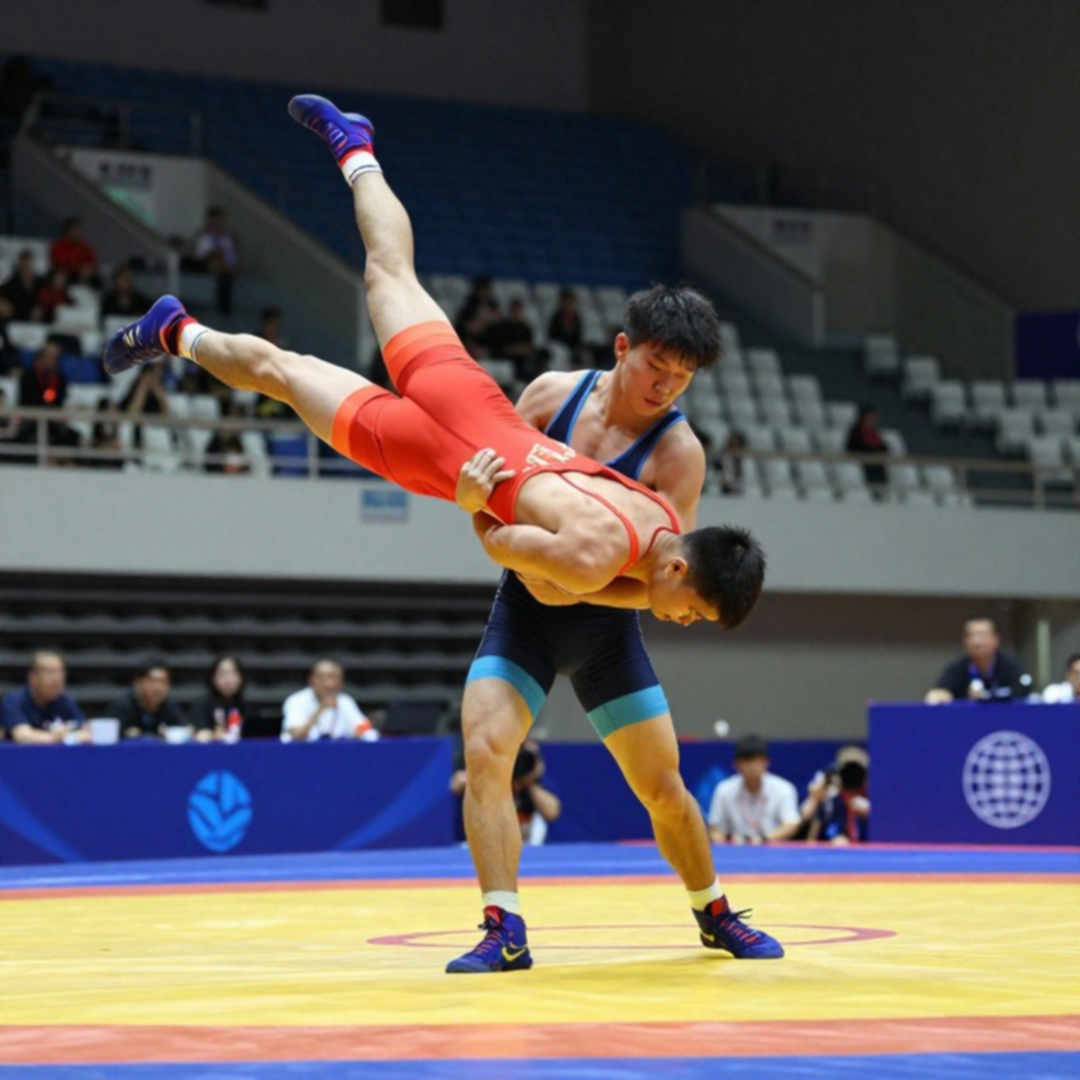
At four in the morning on 4 August 2026 I sat with Ravi Kumar Dahiya's family in Nahri village, Sonipat, and two days later with Bajrang Punia's in Khudan, Jhajjar. What I saw there never reaches a results report: who sweeps the akhada, what the panchayat promised, what the family spent on ghee and travel. That night I decided I would write the budget behind the result rather than the result.
In March 2026 I went looking for fixtures and found a locked pit with a story inside. Six years on, the pit is open, the mud is being turned, and a new date is chalked on the wall. The question is not how many medals India wins at the 2026 Asian Games. It is how many names come off the register before that date arrives — and how many of them will have nobody to tell their story, because they never lost an international match at all. The next time a federation election or a court verdict is debated, ask one question instead: who fixed the date of this season's selection trials, and had that person looked at the UWW ranking calendar first?